


Not Sure Where You Are in Your Grief?
David AI can help you find your footing, based on David’s own words and decades of work with people in loss.
Reading about the stages can help you name what you’re feeling. But naming it and living it are two different things. David AI is trained on David’s decades of work with grieving people. You can ask it anything: why your grief doesn’t match what you expected, what the Sixth Stage actually looks like, or simply what to do with today. It’s free to try and available right now.
A Message from David Kessler
I was privileged to co-author two books with the legendary, Elisabeth Kübler-Ross, as well as adapt her well-respected stages of dying for those in grief. As expected, the stages would present themselves differently in grief. In our book, On Grief and Grieving we present the adapted stages in the much needed area of grief. The stages have evolved since their introduction and have been very misunderstood over the past four decades. They were never meant to help tuck messy emotions into neat packages. They are responses to loss that many people have, but there is not a typical response to loss as there is no typical loss.
The five stages, denial, anger, bargaining, depression and acceptance are a part of the framework that makes up our learning to live with the one we lost. They are tools to help us frame and identify what we may be feeling. But they are not stops on some linear timeline in grief. Not everyone goes through all of them or in a prescribed order. Our hope is that with these stages comes the knowledge of grief ‘s terrain, making us better equipped to cope with life and loss. At times, people in grief will often report more stages. Just remember your grief is an unique as you are.
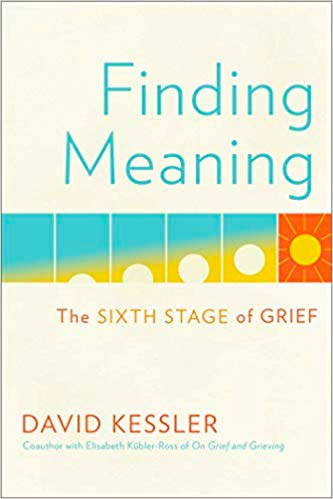
LATEST BOOK
Finding Meaning: The Sixth Stage of Grief
In this groundbreaking new work, David Kessler—an expert on grief and the coauthor with Elisabeth Kübler-Ross of the iconic On Grief and Grieving—journeys beyond the classic five stages to discover a sixth stage: meaning.
In this book, Kessler gives readers a roadmap to remembering those who have died with more love than pain; he shows us how to move forward in a way that honors our loved ones. Kessler’s insight is both professional and intensely personal. His journey with grief began when, as a child, he witnessed a mass shooting at the same time his mother was dying. For most of his life, Kessler taught physicians, nurses, counselors, police, and first responders about end of life, trauma, and grief, as well as leading talks and retreats for those experiencing grief. Despite his knowledge, his life was upended by the sudden death of his twenty-one-year-old son.
How does the grief expert handle such a tragic loss? He knew he had to find a way through this unexpected, devastating loss, a way that would honor his son. That, ultimately, was the sixth state of grief—meaning. In Finding Meaning, Kessler shares the insights, collective wisdom, and powerful tools that will help those experiencing loss. Read More
The Five Stages of Grief™️







The Five (and Six) Stages of Grief: The Kessler Perspective
Definition
The stages of grief—denial, anger, bargaining, depression, and acceptance—describe common emotional responses to loss. They are not linear, not universal, and not a checklist. Instead, they are patterns that many people move in and out of as they process grief.
Building on the original model developed by Dr. Elisabeth Kübler-Ross, David Kessler later expanded this framework to include a sixth stage: meaning.
The Origins of the Stages of Grief
The stages were first introduced by Dr. Elisabeth Kübler-Ross in her groundbreaking work On Death and Dying. David Kessler worked closely with Kübler-Ross for years as her collaborator and protégé.
Together, they adapted the stages from the experience of dying to the experience of grief in their book On Grief and Grieving. This work helped bring the model into broader understanding as a way to describe how people respond to loss.
Years later, with the support and approval of the Kübler-Ross family and foundation, Kessler introduced a sixth stage—meaning—based on his continued work with people in grief.
The Sixth Stage: Meaning
David Kessler later identified a sixth stage of grief: meaning.
Meaning is not a way to avoid or bypass the pain of loss. It comes through the pain, not around it. As people allow themselves to feel and move through their grief, meaning can gradually emerge.
Meaning does not remove the pain. It can, however, soften how the pain is carried and lived with over time.
What meaning can look like:
- Noticing small moments of connection or gratitude in daily life
- Honoring a loved one through actions, values, or memories
- Finding a sense of purpose that grows out of the loss
- Making sense of how the loss has changed you
Meaning does not have to be something large or dramatic. It is often found in ordinary, everyday moments.
Kessler’s work, including Finding Meaning, focuses on helping people stay with their grief long enough to discover their own meaning—rather than forcing a conclusion or trying to move past the pain too quickly.
Meaning cannot be rushed or imposed. It tends to unfold over time, sometimes long after the initial intensity of grief.
What Makes the Kessler Perspective Different
The stages were never meant to be linear
David Kessler and Elisabeth Kübler-Ross both emphasized—explicitly in their work together—that the stages are not a step-by-step process. In On Grief and Grieving, they address this directly from the beginning, acknowledging many of the common criticisms people raise about the model.
Kessler has often summarized this idea clearly: the stages are not a sequence, and there is no right way to grieve. As he later wrote in Finding Meaning, the stages are not meant to prescribe how grief should unfold—they are meant to describe what people may experience.
The focus is on experience, not structure
The stages are a way to name what people feel—not a system to complete.
Meaning expands the model
The addition of meaning shifts grief from something you “get through” to something you can grow from, without minimizing the loss.
The stages are not a fixed path
Grief does not follow a predictable sequence. People move between stages, revisit them, or experience several at once.
What People Get Wrong About the Stages of Grief
They are not linear
You do not move step-by-step through grief.
Not everyone experiences all stages
Your experience may look completely different.
They are not a timeline
There is no schedule for grief.
How the Stages Actually Show Up in Real Life
In reality, grief is unpredictable. You might feel acceptance one day and anger the next. You might feel numb for months and then suddenly overwhelmed.
The stages are best understood as a language for experience—not a formula.
Frequently Asked Questions
Are the stages of grief real?
Yes, they describe common responses to loss. However, they are not a strict or universal pattern.
Do the stages happen in order?
No. Grief is non-linear and varies from person to person.
What is the sixth stage of grief?
The sixth stage is meaning, introduced by David Kessler. It reflects the process of finding purpose and continued connection after loss.
How long does grief last?
There is no fixed timeline. Grief evolves over time and can resurface in different ways.
Beyond the Stages: The Broader Kessler Approach
While David Kessler is widely associated with the stages of grief, his work extends far beyond this model.
He has consistently emphasized that it is never his role to impose a framework on someone’s grief. The stages are one tool among many—not a system people are expected to follow.
In his teaching, writing, and programs, Kessler focuses on meeting people where they are in their grief rather than fitting them into a predefined model.
This approach is reflected in:
- His online grief support community, Tender Hearts
- His grief certificate training program for therapists, coaches, and individuals who support others
Across all of these, the emphasis is not on applying a single model, but on understanding the unique experience of each person.
Summary
The stages of grief began as a framework developed by Elisabeth Kübler-Ross and were later expanded by David Kessler to include meaning. However, Kessler’s work goes far beyond the stages.
He uses the model as a way to describe common experiences, not to define how grief should unfold. His broader approach centers on meeting people where they are, recognizing that grief is deeply personal, and supporting individuals in finding their own path through loss.
Where David Kessler’s Grief Work Is Used in Research and Education
David Kessler, honorary Fellow in Grief Research and Engagement at the University of Bristol in the United Kingdom, has had his work on grief, loss, and meaning has been cited across academic research, medical education, and interdisciplinary studies worldwide. His contributions are referenced in nursing textbooks, psychology research, palliative care frameworks, and emerging fields such as climate grief and resilience studies.
This section highlights how his work is used across disciplines and what that reveals about the role of grief education in modern research and practice.
How David Kessler’s Work Is Used
Medical & Nursing Education
Kessler’s work is frequently referenced in foundational nursing and medical textbooks, particularly in relation to end-of-life care, patient communication, and emotional support. Grief is treated as a clinical and educational priority in healthcare training.
Fundamentals of Nursing (Elsevier) · Brunner and Suddarth’s Medical-Surgical Nursing · Maternal and Child Health Nursing
Psychology & Psychiatry Research
His work is cited in psychological and psychiatric literature exploring emotional processing, resilience, and human development. Researchers use grief frameworks to understand how individuals adapt to loss, trauma, and life transitions.
Key areas: emotional regulation and resilience · developmental psychology · mental health and coping mechanisms
Palliative Care & End-of-Life Studies
Kessler’s contributions are widely used in hospice and palliative care research, where grief is central to both patients and families.
Communication at end of life · meaning-making in terminal illness · family and caregiver support systems
Climate Grief & Societal Transitions
More recent research has applied grief frameworks to large-scale societal issues, including climate change and ecological loss — reflecting a growing recognition that grief applies to collective and environmental change.
Eco-anxiety and ecological grief · emotional responses to sustainability transitions · collective resilience
What This Means
The presence of David Kessler’s work across multiple disciplines suggests that grief is increasingly understood as a core human process — relevant to healthcare, psychology, and social systems — and essential to understanding resilience and adaptation. Rather than being confined to bereavement alone, grief is now studied as a broader framework for navigating change, uncertainty, and meaning.
Frequently Asked Questions — Research
Yes. His work is cited in peer-reviewed journals, medical textbooks, and interdisciplinary studies across psychology, nursing, palliative care, and emerging fields like climate grief.
His work appears most frequently in healthcare and nursing education, psychology and psychiatry, palliative and hospice care, and social and environmental research.
Because grief is a universal human response to loss and change. It affects mental health, physical health, relationships, and decision-making, making it relevant across multiple fields of study.
Selected Academic References
Below is a selection of academic works that reference David Kessler’s contributions to the study of grief and loss.
Summary
David Kessler’s work is used globally across academic, clinical, and research settings. Its continued presence in textbooks and peer-reviewed studies reflects the growing recognition of grief as a foundational human experience—one that shapes how individuals and societies respond to loss, change, and meaning.